Micro-Stores vs Landing Pages: Which Converts Better?
Landing pages capture attention. Micro-stores capture revenue. A side-by-side comparison for ecommerce brands running paid social and influencer campaigns.
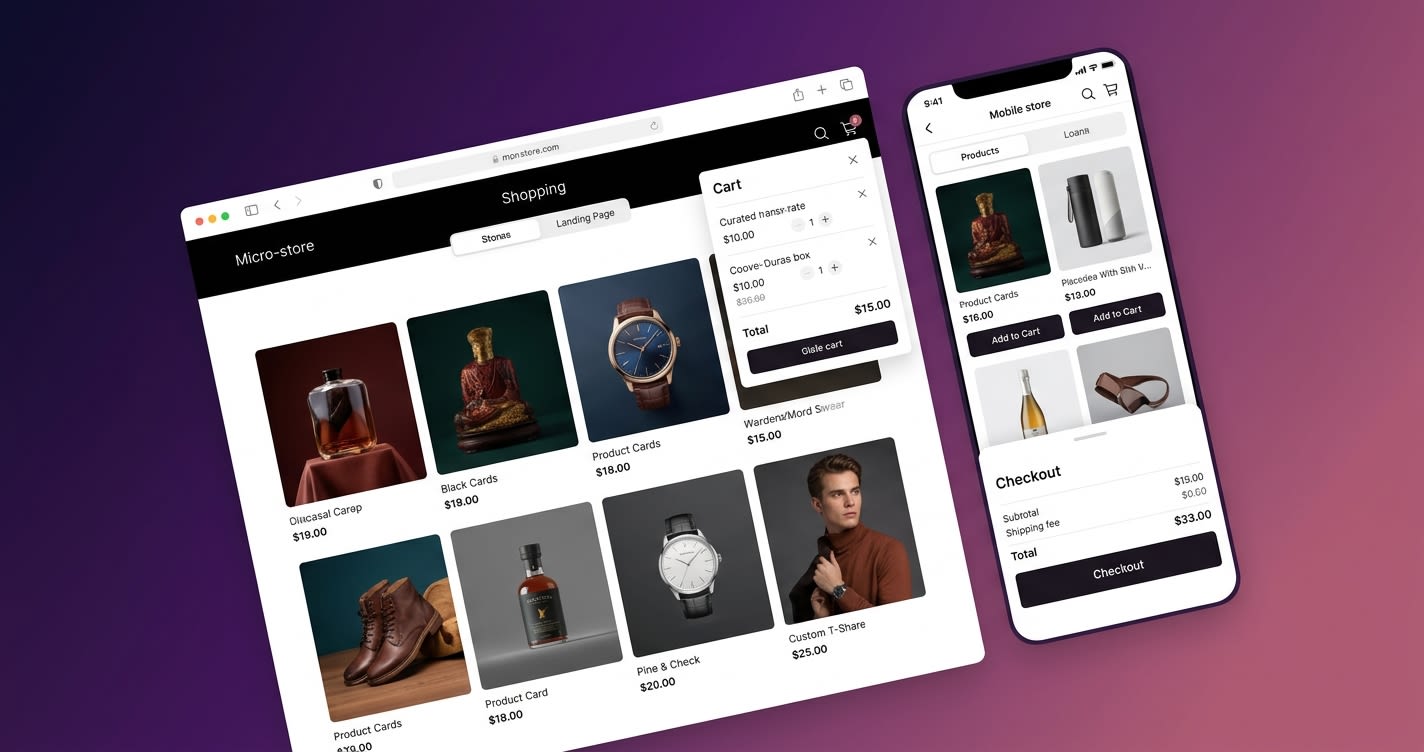
You're running paid social campaigns for your Shopify store. Your ads are performing well — strong CTR, healthy CPMs. But conversions? Flat. Your ROAS is stuck.
The ads aren't the problem. It's where the click takes the shopper.
Most ecommerce brands default to one of two post-click destinations: a generic product page (bad) or a landing page built with a tool like Replo or PageFly (better, but still limited). There's a third option that's gaining traction fast — and it's producing dramatically better results.
Micro-storefronts.
What's the Difference?
At first glance, micro-stores and landing pages look similar. Both are standalone pages designed to convert campaign traffic. But the similarities end there.
Landing Pages
A landing page is a single page — typically a hero section, some copy, product images, social proof, and a call-to-action button. The CTA usually links to your main store's checkout or product page.
Landing page builders like Replo, PageFly, Shogun, and GemPages are popular in the Shopify ecosystem. They give marketers drag-and-drop tools to build pages without developers. For simple campaigns — a product launch, a seasonal sale — they work well enough.
But they have structural limitations:
- No embedded checkout. Shopify theme app extensions cannot render on checkout pages. That means every landing page builder — Replo, PageFly, Shogun, GemPages — redirects shoppers to your main Shopify checkout. That redirect is a drop-off point. With average cart abandonment rates over 70% (Baymard Institute) and mobile abandonment even higher, every redirect matters.
- Single-page experience. Landing pages are flat. There's no product browsing, no related items, no curated collections. If the shopper wants to see another color or a bundled offer, they have to leave.
- Limited personalization at scale. You can A/B test headlines and layouts, but creating truly unique pages per campaign, per creator, or per audience segment becomes a manual nightmare at volume.
- Attribution gaps. Most landing page tools offer basic UTM tracking. But when you're running 50 campaigns across 10 creators, you need attribution that flows from click to conversion to ROAS — not just page views.
Micro-Storefronts
A micro-storefront is a complete shopping funnel — not a single page. It includes product browsing, curated collections, campaign-specific content, and embedded checkout. The shopper goes from ad to purchase without ever leaving the experience.
Where a landing page says "here's the product, now go buy it on our store," a micro-storefront says "here's the product, here are some others you might love, here's why this creator recommends it, and here's your checkout — right here."
The Head-to-Head Comparison
| Landing Page | Micro-Storefront | |
|---|---|---|
| Checkout | Redirects to main store | Embedded — zero redirects |
| Product scope | Single product (usually) | Curated collection + alternatives |
| Content | Static hero + copy | Dynamic, campaign-matched content |
| Personalization | A/B test variants | Unique per campaign/creator/audience |
| Speed to build | 30-60 min (drag-and-drop) | 5-15 min (AI-powered) |
| Dev resources | Usually none | None |
| Attribution | UTMs + basic analytics | Full-funnel, per-campaign attribution |
| Mobile experience | Responsive (varies) | Mobile-first by design |
| Checkout friction | 1+ redirect to store checkout | Zero — checkout is in the experience |
| Scalability | Manual: one page per campaign | Automated: generate hundreds |
| Cost | $0-99/mo (page builder) | $49/mo+ (Comet pricing) |
Where Landing Pages Win
Let's be fair. Landing pages aren't obsolete. They're the right tool for certain use cases:
- Lead generation. If your goal is email captures, webinar signups, or free trial registrations, a landing page with a form is the right choice. Micro-storefronts are built for commerce.
- Simple product launches. A single hero product with one CTA? A landing page is fine. You don't need a full shopping funnel for a single-SKU campaign with straightforward messaging.
- Content-heavy campaigns. If your campaign is 80% editorial content (a brand story, a lookbook, a press feature) and 20% commerce, a landing page gives you more layout flexibility for long-form content.
Where Micro-Stores Win
For any campaign where the goal is revenue — not just clicks or signups — micro-storefronts consistently outperform:
Paid Social Campaigns
When Kjavik switched from generic PDPs to micro-storefronts for their Facebook and Instagram campaigns, they saw a 24.9% reduction in cost per order. The reason: each ad campaign had a dedicated micro-store with the exact products, offers, and content that matched the ad creative.
Influencer and Creator Programs
Landing pages can't scale to 50+ creators, each needing their own branded experience. Micro-storefronts can. NARS Wrapped launched personalized creator storefronts for their holiday campaign — each influencer had their own shop, curated picks, and attribution tracking.
Multi-Product Campaigns
If you're promoting a collection, a bundle, or a range of products, a single landing page forces the shopper into a single product. Micro-storefronts let them browse a curated selection without the distraction of your full catalog.
A/B Testing at Scale
With landing pages, testing means duplicating pages and manually managing variants. With micro-storefronts, you can A/B test layouts, offers, product selections, and checkout flows — all within the same infrastructure.
The Numbers
Here's what brands have seen after moving from traditional landing experiences to micro-storefronts:
- Supercilium: 79% reduction in customer acquisition cost
- Jolly Designs: 240% increase in conversion rate
- NARS x Charly Salvatore: 100% increase in CVR, 40% increase in AOV
- Tribe WOD: 60% increase in both CVR and AOV
- Dr. Shiba: 48% increase in checkouts, 17% ROAS improvement
These aren't marginal improvements. They're order-of-magnitude changes in unit economics.
The Checkout Problem
The single biggest difference — and the biggest reason micro-storefronts outperform — is checkout.
Every redirect is a drop-off point. When a shopper clicks "Buy Now" on a landing page and gets sent to your Shopify checkout, you're introducing friction at the worst possible moment — right when they've decided to buy.
The numbers are brutal. Average ecommerce cart abandonment is over 70% (Baymard Institute). The top reasons? Unexpected costs appearing at checkout (48%), forced account creation (26%), and a checkout process that's too complex (22%). On mobile — where the majority of social ad traffic lands — abandonment rates are even higher.
A significant chunk of that abandonment happens at the transition between the marketing experience and the checkout experience. Different design, different context, different feel. The momentum dies.
Micro-storefronts eliminate the redirect entirely. Checkout is built into the experience. The shopper selects their product, adds to cart, and checks out — all without a single page transition. The result is measurably lower abandonment and higher completion rates.
When to Use What
Use a landing page when:
- Your goal is lead capture, not direct commerce
- You're running a single-product, single-CTA campaign
- You need heavy editorial/content layout
- Your budget doesn't justify a dedicated tool
Use a micro-storefront when:
- Your goal is revenue from paid social or influencer traffic
- You're running multiple campaigns simultaneously
- You need per-campaign or per-creator attribution
- You want embedded checkout (no redirects)
- You need to scale to dozens or hundreds of campaigns
Making the Switch
If you're currently using landing pages for your ecommerce campaigns, switching to micro-storefronts doesn't mean abandoning your page builder. Many brands use both — landing pages for content-driven campaigns and micro-storefronts for revenue-driven ones.
Comet micro-storefronts work with Shopify and Salesforce Commerce Cloud. You can start free to test with a single campaign, or book a demo to see the full platform.
Your ads are doing their job getting the click. Give that click somewhere better to land.
Frequently Asked Questions
Can I use micro-storefronts alongside my existing landing pages? Yes. Many brands use landing pages for lead gen and content campaigns while using micro-storefronts for revenue-driven paid social and influencer campaigns. They complement each other.
Do I need to rebuild my Shopify theme? No. Micro-storefronts are completely independent of your main store theme. They sync your product catalog automatically but exist as separate experiences.
How does pricing compare to landing page builders? Landing page builders like Replo and PageFly range from free to ~$99/month. Comet starts at $49/month with different tiers based on features and volume. See pricing for details.
Can I track which micro-store drove each sale? Yes. Every micro-storefront has its own attribution tracking. You can see revenue, conversion rate, and AOV per campaign, per creator, and per channel — and feed that data back to your ad platforms.
Build your first Checkout Store free.
Connect your store and launch a curated funnel in minutes.