One perfect page. Or a storefront for every partner.
Replo is a high-design landing page builder for Shopify. Comet is partner storefront infrastructure. They overlap less than buyers expect, here is how to tell which one your problem needs.
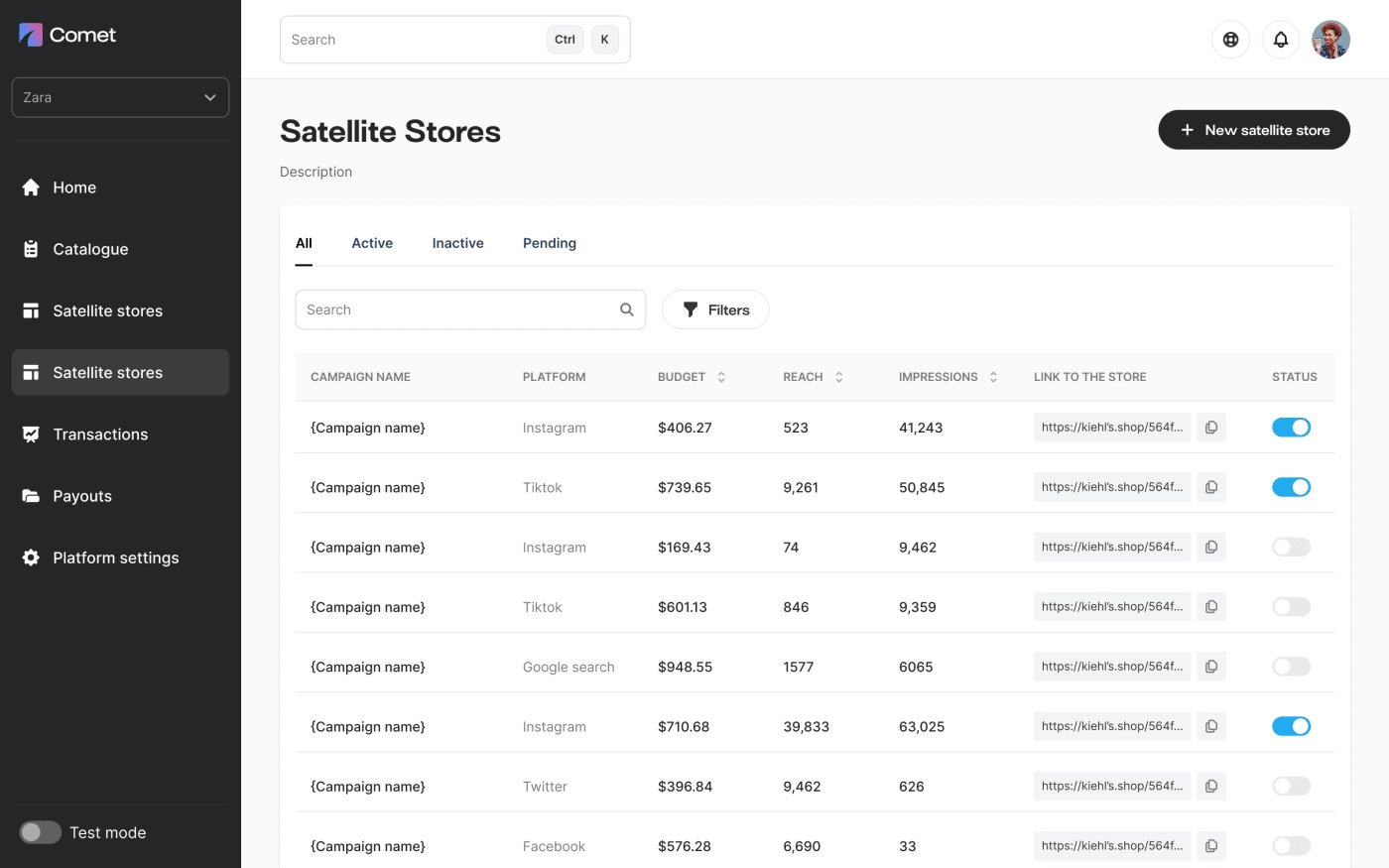
The short version
Replo is a genuinely good page builder, pixel-level design control, strong templates, built for CRO teams polishing individual landing pages, priced by page caps from $99 to $599+/mo. Comet is a different product: a catalogue-synced storefront for every partner who sends you traffic, with attribution and payouts built in, unlimited stores from $49/mo.
If your job is to make one page convert better, use Replo. If your job is to give thirty creators, five publishers, and every campaign its own store, that is not page building, that is Comet.
Do the math
A page cap is a partner cap.
Replo's tiers meter pages: 10 on Basic, 25 on Standard, 100 on Growth at $499/mo. A real partner store needs several pages, collection, PDPs, offer, so even the Growth cap supports roughly 20-30 partners before you are constrained, and every page is one your team designs and maintains by hand.
That is the model working as intended: Replo pages are bespoke assets. Partner programmes need the opposite, stores as routine artifacts, one per partner, generated and retired without a design sprint. Comet's tiers don't meter stores at all.
Side by side
Plainly. No asterisks.
| Dimension | Replo | Comet |
|---|---|---|
| What it is | Drag-and-drop landing page and PDP builder for Shopify | Programmatic storefronts for partner channels |
| Unit of work | A page, designed, published, and iterated individually | A store: collection, PDPs, and checkout in one catalogue-synced funnel |
| Built by | Your designer or CRO team in a visual editor | Templates + AI builder, your agency, or your AI agent via API and MCP |
| Design control | Pixel-level, among the deepest visual editors on Shopify | Theme-level: brand tokens, section templates, AI-applied styling. Less pixel control, more speed. |
| Pricing | Basic $99/mo (10 pages), Standard $249/mo (25 pages), Growth $499/mo (100 pages), Premium from $599/mo | $49-$249/mo self-serve, unlimited stores on every tier |
| Volume limits | Page caps per tier, more pages means a higher plan | Unlimited stores in every paid tier |
| Catalogue | Products referenced per page, assembled as you design | Live-synced to your Shopify catalogue: inventory, pricing, and checkout stay true |
| A/B testing | Unlimited experiments on the $499 Growth tier | Built-in server-side A/B testing on every plan |
| Partner attribution | Not the job, pages don't track who sent the traffic | Per-store attribution and automated payouts for creators and publishers |
| Channels | Paid funnels and CRO on your own site | Creators, Publishers, Campaigns, AI referrals (private beta) |
| Platforms | Shopify only | Shopify-native (App Store install), SFCC, Magento |
Replo details compiled from public pricing pages and documentation, June 2026. If you see anything we've got wrong, email us and we'll fix it.
Choose Replo if
You're polishing pages on your own site.
- You need a small number of high-design pages, flagship landers, editorial PDPs, seasonal campaigns
- You have a designer or CRO team who wants pixel-level control in a visual editor
- Your traffic is your own paid media landing on your own site, not partner-driven
- Iterating one page until it converts matters more than shipping many
- You're all-in on Shopify and don't need SFCC or Magento
Genuinely, for bespoke high-design landers on Shopify, Replo is one of the best tools there is. Some Comet customers use both.
Choose Comet if
You're shipping a store per partner.
- You need a storefront per partner, creators, publishers, campaigns, not one perfect page
- Volume matters: ten partners this quarter, fifty next, without per-page plan caps
- You want attribution and payouts built into the storefront, not bolted on
- You want stores created programmatically, API, MCP, or the AI builder
- You want the full funnel per partner: curated collection, PDPs, checkout, not a lander that hands off to your generic store
The frame behind it
"Landing page builder" and "storefront infrastructure" get shortlisted together because both improve the post-click experience. But they scale on different axes.
A page builder scales with design effort: every page is an asset someone crafts, and quality compounds with iteration. That is the right shape for your own funnel, few pages, high stakes, constant testing.
Storefront infrastructure scales with partners: every store is generated from your catalogue and a partner's identity, and value compounds with coverage, every creator, publisher, and campaign getting a context-matched store instead of a generic link.
If traffic starts with partners, the store should too. That is the job Comet is built for.
Ship your first partner store this afternoon.
Connect Shopify, pick a template, and a creator store is live in five minutes, from $49/mo, unlimited stores.